
Hair loss creates more than skin-deep damage because it affects how people see their physical appearance. Your daily activities become more difficult to manage because hair loss affects your self-perception.
The process of hair restoration begins for people who notice their hairline moving back while their hair becomes thinner and their scalp shows visible bald spots.
The research process will reveal two main methods that researchers need to study carefully which are FUE and FUT.
Hair restoration surgery applied through these two methods achieves the same result of natural hair growth yet they use different techniques for hair follicle collection and transplantation, produce different healing experiences and scar patterns and vary in their price structures.
In this guide, you will understand a complete comparison of FUE vs FUT hair transplant in Singapore, including the benefits, drawbacks, recovery process, and costs associated with each technique. Whether you are considering a Hair Transplant in Singapore for the first time or exploring your treatment options, this guide will help you make an informed decision.
Before comparing transplant methods, it helps to understand why hair loss happens and how it progresses.
Hair loss develops through multiple causes, yet androgenic alopecia stands as the primary reason because it leads to male and female pattern baldness in people.
The condition develops because of genetic factors and hormonal influences but medical
conditions including thyroid disorders, certain medications, poor nutrition and ongoing stress also play a role.
The body loses about 50 to 100 hairs every day because this amount represents the standard hair shedding during normal hair development. The body of a healthy person will grow new hairs to replace the ones that fall out.
The hair follicles in pattern baldness start to reduce their size until they stop creating new hair which results in hair loss that produces bald spots and hair thinning.
A hair transplant moves hair follicles that still grow hair from the back and sides of your head to places where you have lost hair.
The transplanted follicles will keep producing hair which creates a permanent solution that looks like your natural hair.
FUE Hair Transplant in Singapore has become one of the most popular hair restoration techniques because it combines flexibility with minimal scarring.
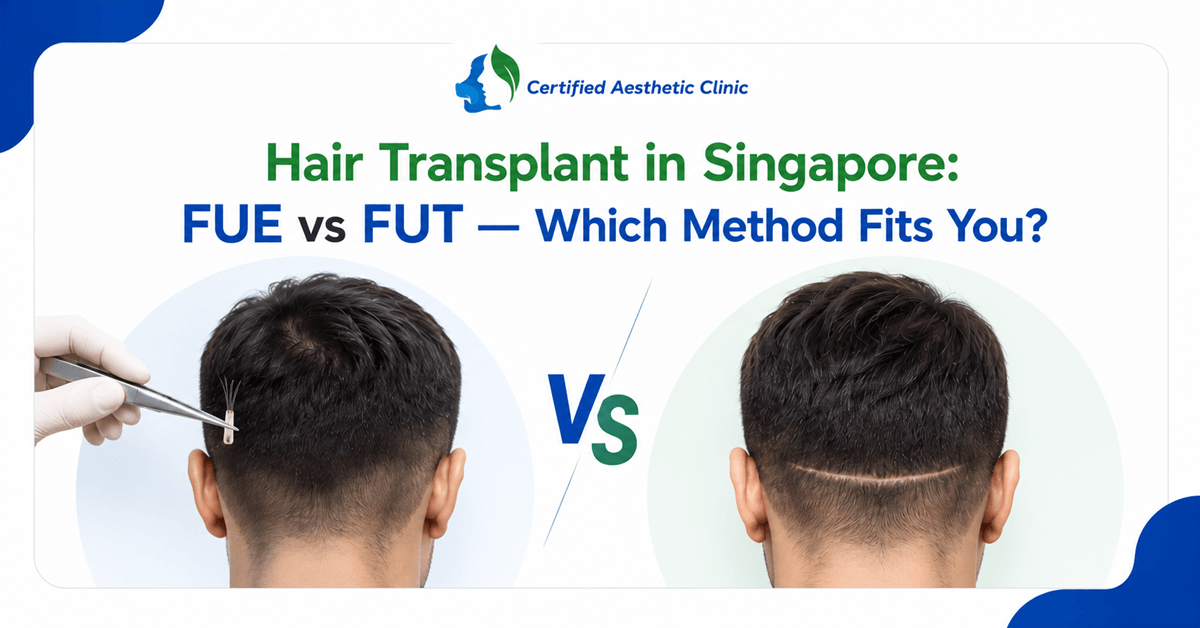
FUE, or Follicular Unit Extraction, is a hair transplant technique that removes individual hair follicles rather than a strip of scalp.
The donor area is first trimmed very short, allowing the surgeon to extract follicular units one by one using a specialised micro-punch tool.
The harvested grafts are carefully preserved before being implanted into tiny recipient sites created in the thinning or bald areas.
FUE is a meticulous process and generally takes longer than FUT.
A full treatment session may last between eight and ten hours, although patients remain comfortable under local anaesthetic throughout the procedure.
The main benefit of FUE surgery results in producing almost no visible scarring after the operation. The operation produces small dot-shaped marks which remain hidden under brief haircuts.
The FUE method provides a perfect solution for patients who want to heal quickly while keeping their scalp free of straight scars and who develop noticeable scarring.
The method serves as a suitable treatment choice for people who need less than average amounts of grafts.
Also Read:Is Mole Removal in Singapore Painful? What to Expect Before, During and After
FUE vs FUT Hair Transplant Singapore — A Direct Face-Off
When comparing FUE vs FUT hair transplant in Singapore, it is important to evaluate factors such as scarring, recovery time, graft yield, procedure duration, and overall cost.
FUT leaves a linear scar across the back of the scalp. While it is usually hidden by longer hair, it may become visible with shorter hairstyles.
FUE creates tiny circular scars that blend into the scalp and are far less noticeable.
Winner for scarring: FUE
FUT can generally provide a larger number of grafts in a single session, making it suitable for extensive hair loss.
FUE typically yields fewer grafts per procedure but remains effective for moderate restoration needs.
Winner for graft number: FUT
Because FUT involves removing a strip of scalp tissue, the harvesting process is faster. FUE requires individual extraction of each follicle, resulting in a longer procedure.
Winner for surgery time: FUT
FUE usually offers a quicker recovery, with minimal discomfort in the donor area. FUT requires additional healing time due to the incision and stitches.
Winner for healing time: FUE
FUT is generally more affordable, while FUE costs more because it is a labour-intensive and highly specialised procedure.
Winner for cost: FUT
Both techniques can deliver excellent results. The ideal choice depends on your hair characteristics, donor area quality, and restoration goals.
Winner: Depends on your hair type and individual needs.
The right option depends on several personal factors rather than a single feature or benefit.
The right choice depends on your individual hair loss pattern, lifestyle, budget, and treatment goals. Follow these key decision points to determine which method may suit you best.
Medical professionals recommend FUT as the best hair transplant method for patients who need three thousand or more grafts during their surgical procedure.
The system enables doctors to obtain more hair grafts through one surgical operation. FUE stands as a practical solution for hair transplant patients who need up to 2,000 grafts during their treatment sessions.
The FUE method works best for people who want very short hair or a fully shaved scalp because it produces tiny scars that remain hidden.
The FUT technique produces a straight scar which people who keep their hair long can hide because their hair naturally covers the scar area.
People who develop keloid scars or raised scar tissue might find FUE beneficial for their situation.
The healing process of small extraction areas results in minimal visible scars when compared to the straight cut made during FUT surgery.
FUT is usually the more affordable option and can provide excellent results.
If your budget allows for a higher investment, FUE offers the advantage of a quicker recovery and no linear scar.
FUE procedures can take eight to ten hours, while FUT is often completed within four to six hours. Patients who prefer a shorter surgery may find FUT more comfortable.
A reputable hair transplant clinic will assess your scalp laxity, donor hair density, and overall suitability before recommending the most appropriate technique based on your needs rather than financial considerations.
Recovery plays a major role in the overall experience, so it helps to know what to expect.
Day 1 to 3: The donor area feels tight and sore so you take pain medication and rest with your head propped up on pillows.
A hair transplant clinic in Singapore will provide written aftercare instructions, which you should follow carefully. Avoid scratching or picking at scabs, and protect your scalp from direct sunlight for at least one month.
Finding the right Hair Transplant clinic in Singapore is just as important as choosing the right procedure. The quality of the surgeon and medical team will have a direct impact on your final results.
The success of a hair transplant depends less on the technique and more on the surgeon performing it.
Whether you choose FUE or FUT, an experienced specialist can deliver natural-looking results, while poor surgical skills can lead to disappointing outcomes. Prioritise the surgeon before the procedure.
Look for a surgeon who is trained in dermatology or plastic surgery. These specialists undergo extensive education and hands-on training in skin, scalp, and hair restoration procedures.
Their expertise is generally far greater than that of a general practitioner offering cosmetic treatments.
Many patients shortlist providers from the Top 10 aesthetic clinics in Singapore, but rankings alone should not influence your decision. Always evaluate actual patient outcomes, surgeon credentials, and consultation quality.
The evaluation process needs to include studies about patients who display hair characteristics that match their hair loss pattern.
Hair transplantation requires multiple people to work together as a team. The surgical team at experienced clinics performs graft extraction and preparation before they conduct the implantation process.
A skilled and coordinated team helps ensure precision and consistency throughout the procedure.
A thorough consultation should last between 30 and 60 minutes. The surgeon needs to assess donor hair supply together with scalp health and hair qualities and required graft numbers during this period.
The clinics that provide FUE and FUT services will choose the right method for you instead of pushing a specific treatment.
You should visit multiple clinics to compare their medical expertise and treatment advice and cost information before selecting your healthcare provider.
Many patients share similar concerns before deciding on a hair transplant procedure.
No. Both methods deliver natural results when performed well. The natural look springs from how the surgeon places the grafts, not from how they extract them.
A skilled surgeon places grafts at the correct angle, direction, and density. That builds a natural hairline regardless of extraction method.
Yes. Some surgeons use a hybrid approach. They take a small strip for the bulk of the grafts.
Then they use FUE to add extra grafts without making the strip longer. This approach gives you more grafts while keeping the strip scar smaller.
No. The hair follicles taken from the back and sides of your head resist the hormone that causes pattern baldness.
Those follicles keep that resistance after you move them. The transplanted hair stays for life.
But your non-transplanted hair may continue to thin. Some people need a second transplant years later.
You receive local anaesthetic injections in your scalp. The first few injections sting. After that, you feel no pain.
You remain awake but comfortable. Some people take a mild sedative to relax. After the anaesthetic wears off, you feel soreness. Pain medication controls this discomfort.
A hair transplant Singapore clinic will tell you honestly if surgery does not suit you. You may lack enough donor hair.
You may carry an unstable hair loss pattern. You may have a medical condition that slows healing.
In these cases, the clinic may recommend non-surgical options like topical treatments or low-level laser therapy.
Both FUT and FUE remain highly effective hair restoration solutions. Patients seeking the Best Hair Transplant in Singapore should focus on choosing the procedure that aligns with their goals, donor hair characteristics, recovery expectations, and budget. The right choice in the fue vs FUT hair transplant in Singapore debate depends entirely on individual circumstances.
FUE offers faster healing and does not leave a noticeable scar. However, it usually costs more and takes longer to complete. Neither method is better for everyone, as each option suits different needs and goals.
Your job is to match your needs to the right method. How many grafts do you need? How short do you wear your hair? How fast do you want to recover? What fits your budget?
Once you answer these questions, visit a hair transplant clinic in Singapore for a consultation. Bring your questions, look at their results, and listen to their recommendation.
Copyright © 2026 Certified Aesthetic. All rights reserved.